
Home › Septic Repair
Septic Repair and Leach Field Replacement in Massachusetts and New Hampshire
Some septic problems are a part: a cracked tank, a broken pipe, a pump or alarm that quit, a distribution box that settled. Others mean the leach field itself has stopped taking water. Either way the fix almost always runs through a permit, and the rules differ by state. Call (978) 486-7980 or send the form. A person reads every request and replies with what happens next.
- Free for homeowners
- Installer permits checked first
- State rules explained
Ask About Septic Service in Your Area
Tell us what you're seeing, or what the inspection report said. A person reads it and replies with what happens next.
Please add your name, a 10-digit phone number and a valid email.
Your request didn't go through on our end. Please call (978) 486-7980 so it isn't lost.
Too many requests have come from this connection in a short time. Please call (978) 486-7980 and we'll take it from there.
We couldn't finish the spam check. Wait a moment and send it again, or call (978) 486-7980.
Repair or replace
A broken part, or a field that has given out
Parts that can be fixed. On the Massachusetts inspection form, a metal tank over 20 years old, a leaking or structurally unsound tank, pumps or alarms that don't work, broken or obstructed pipes, and a broken, settled or uneven distribution box are conditional-pass items: the system passes once the part is replaced or repaired with Board of Health approval (Title 5 inspection form).
When the field is the problem. Sewage backing up into the house, effluent breaking out or ponding on the ground, or a disposal area sitting in groundwater points past a single part. "Soil absorption systems and cesspools cannot be repaired under a conditional pass" in Massachusetts (MassDEP), and New Hampshire law defines a failed system as one that does not properly contain or treat sewage, including discharge to the ground surface or a disposal area in the seasonal high groundwater (RSA 485-A:2).
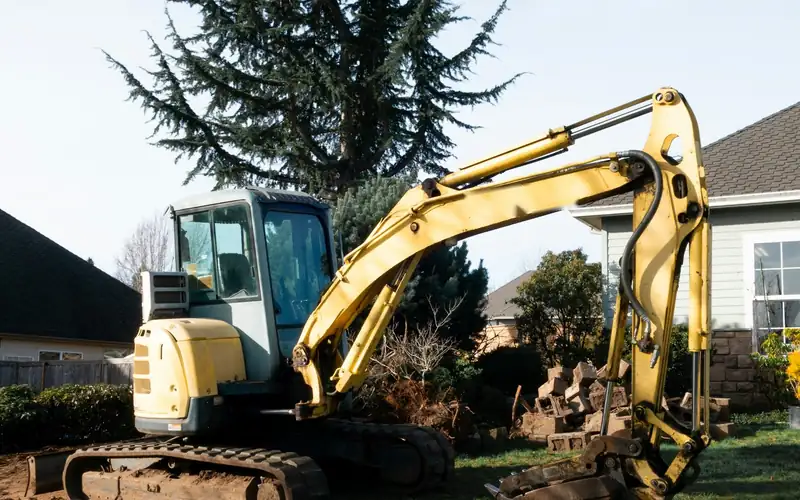
Digging. Replacement means excavation. In both states the excavator must premark the dig area and notify Dig Safe at least 72 hours ahead, not counting weekends and legal holidays; New Hampshire specifies white markings (M.G.L. c.82 §40A, RSA 374:51).
If sewage is surfacing. Keep people and pets away from it and call your Board of Health or town health officer. Repairs on a septic system are not a do-it-yourself job.
Massachusetts
Repairing a Massachusetts septic system
The Board of Health approves it. MassDEP says the local board of health "needs to approve all upgrades and most repairs," and Title 5 allows up to two years to finish them (MassDEP consumer tips). Even replacing one component, such as a tank or distribution box, requires a Disposal System Construction Permit and a Certificate of Compliance when the work is done (Title 5 repairs FAQ). Boards may adopt rules stricter than Title 5 (310 CMR 15.003).
A replacement field. A replacement needs a design from a registered sanitarian or a Massachusetts-registered professional engineer (310 CMR 15.002). Where a lot can't fit a fully conforming system, the Board of Health can grant a Local Upgrade Approval to upgrade an existing system "to the maximum feasible extent," and a variance only where enforcing Title 5 would be "manifestly unjust" and the owner shows equal environmental protection (Title 5, MassDEP ADU guidance). If connecting to sewer is feasible, an existing system generally can't be upgraded or expanded instead (310 CMR 15.004).
The contract. MassDEP advises making sure the contract spells out the work plan, the cost, the payment terms and any guarantees before you sign (MassDEP consumer tips).
Paying for it. For a principal residence, the state tax credit is 60% of qualifying costs up to $30,000, capped at $4,000 a year and $18,000 in total, with the excess carried forward up to five years, for tax years beginning on or after January 1, 2024 (M.G.L. c.62 §6(i), DOR). Towns in the Community Septic Management Program lend to homeowners at 0%, 2% or 4% depending on income, as listed in November 2026 (CSMP), and MassHousing describes low- and no-interest septic repair loans of up to $25,000; its page doesn't say whether applications are open, so ask a participating lender or call MassHousing at 617-854-1000 (MassHousing).
New Hampshire
Repairing a New Hampshire septic system
Through a permitted designer. When the disposal area of a home's system needs repair or replacement, the owner works through an NHDES-permitted designer to get the approvals, starting with a permit by rule for in-kind repair or replacement (Env-Wq 1004.18). Installation for hire takes an NHDES installer's permit (RSA 485-A:36), and the system must be inspected before it is covered or put back into use (RSA 485-A:29).
Near the water. A replacement system in the protected shoreland must meet the shoreland setbacks to the maximum extent feasible (RSA 483-B:9), and on developed waterfront a buyer who takes on a failing system must replace it within 180 days of the transfer (RSA 485-A:39).
The owner's duty. Owners must keep a system from causing a nuisance or health hazard; NHDES may inspect and issue compliance orders, and local health officers keep their own authority (RSA 485-A:37).
The contract. The Attorney General's office advises a written contract with the scope, materials, total price and payment schedule before any work or payment, and treats a down payment over 50% as a warning sign (NH Attorney General). On contracts over $5,000 for building or improving a home, the residential construction defects law may require a written notice of its claims process (RSA 359-G).
New Hampshire septic rules and the towns we cover.
Last verified November 2026. Fees, restrictions and deadlines on this page are due for re-checking by January 2027. New England Septic Pros is a referral service. We don't dig, repair or file permits.
FAQ
Septic repair questions
Can a failing leach field be repaired instead of replaced?
In Massachusetts, a soil absorption system or cesspool cannot be repaired under a conditional pass. Problems such as a leaking tank, broken pipes or an uneven distribution box can be. In New Hampshire, replacing a residential disposal area starts with a permitted designer and the NHDES approvals.
Do I need a permit just to replace a tank or distribution box in Massachusetts?
Yes. MassDEP says even replacing a single component requires a Disposal System Construction Permit and a Certificate of Compliance once the work is done.
How long do I have to fix a failed system in Massachusetts?
MassDEP says a failed system must be upgraded within two years unless the Board of Health or MassDEP approves a different schedule, and that applies even if you are not selling.
Is there help paying for a septic repair?
In Massachusetts, the state tax credit covers 60% of qualifying costs up to $30,000, capped at $4,000 a year and $18,000 in total, for a principal residence. Some towns lend through the Community Septic Management Program, and MassHousing describes septic repair loans of up to $25,000.
What does it cost me to use New England Septic Pros?
Nothing. The request and the referral are free; the contractor prices the work.
Town guides
Local rules for septic repair by town
Each town page covers who permits septic work there, the town's own septic rules and where public sewer reaches. Towns with a local guide so far: Greater Lowell, MA (Lowell, Chelmsford, Dracut, Tewksbury, Billerica, Westford, Tyngsborough and Pepperell), Andover, Lawrence & Haverhill, MA (Methuen, Lawrence, Andover, North Andover and Haverhill), Woburn, Reading & Melrose, MA (Woburn, Lexington, Burlington, Wilmington, North Reading, Reading, Wakefield, Melrose, Stoneham and Winchester), Nashua Region, NH (Nashua, Hudson and Merrimack), Salem, Derry & Londonderry, NH (Pelham, Salem, Windham, Derry and Londonderry), Manchester & Bedford, NH (Manchester and Bedford) and Portsmouth, Dover & Rochester, NH (Portsmouth, Dover and Rochester). We add towns across New England as we can cover them properly.
Other jobs